

Who Invented the Sewing Machine?
Ask ten people who invented the sewing machine, and many will answer “Isaac Singer.” That answer is understandable because the Singer name became one of the most recognized brands in sewing history. However, the true story is more layered. The sewing machine was not invented by one person in a single moment. It developed through decades of experiments, patents, improvements, legal disputes, and practical engineering. Elias Howe is most often credited with inventing the first practical lockstitch sewing machine in the United States, receiving U.S. Patent No. 4,750 in 1846, but other inventors, including Thomas Saint, Barthélemy Thimonnier, Walter Hunt, and Isaac Merritt Singer, all played major roles in shaping the machine we recognize today.

The Short Answer: Elias Howe Is Usually Credited
Elias Howe, an American inventor from Massachusetts, is generally credited with inventing the first practical sewing machine using a lockstitch design. His 1846 patent included several features that became central to modern sewing machines, including an eye-pointed needle, a shuttle beneath the cloth, and an automatic feed mechanism.
That does not mean Howe invented sewing automation from nothing. Before Howe, several inventors had imagined, designed, patented, or even built sewing machines. What made Howe’s work historically important was that his machine brought together practical mechanical principles in a way that could form strong, repeatable stitches.
In other words, Howe did not invent the desire to mechanize sewing. He helped solve one of the most important mechanical problems: how to create a reliable stitch by machine.
Why the Sewing Machine Was Such a Revolutionary Invention
Before sewing machines, clothing, household textiles, uniforms, upholstery, and industrial fabric goods were stitched by hand. Skilled hand sewing required time, patience, and physical endurance. A single garment could take many hours, and large-scale production depended on armies of workers performing repetitive hand labor.
The sewing machine changed that. It accelerated production, lowered the cost of finished goods, and helped transform both home sewing and factory manufacturing. Its impact reached far beyond clothing. Sewing machines affected:
Garment manufacturing
Tailoring and alterations
Shoe and leather work
Upholstery
Sailmaking
Quilting
Household textile production
Industrial stitching systems
Repair and maintenance trades
The sewing machine also created entirely new service industries. As machines became common in homes, factories, schools, and shops, people needed technicians who understood timing, tension, feed systems, hook assemblies, needle systems, motors, belts, and mechanical restoration.
That technical knowledge remains valuable today.
Early Attempts Before Elias Howe
The idea of a sewing machine appeared long before Howe’s 1846 patent. In 1790, English inventor Thomas Saint patented a machine intended for sewing leather and canvas. His design is often cited as one of the earliest sewing machine patents, although it is unclear whether Saint built a fully successful working model during his lifetime.
In 1830, French tailor Barthélemy Thimonnier patented a machine that used a chain stitch. Thimonnier’s machine was significant because it was not merely theoretical. He built machines and used them in an attempt to produce uniforms for the French army. However, his work faced fierce resistance from tailors who feared that machines would threaten their livelihoods. Historical accounts describe his workshop being attacked and machines being destroyed.
These early efforts show that the sewing machine was not the product of one sudden breakthrough. It was part of a broader industrial push to mechanize skilled manual work.
Walter Hunt and the Unpatented Breakthrough
Another important figure is Walter Hunt, an American inventor who developed a sewing machine in the early 1830s. Hunt’s machine reportedly used an eye-pointed needle and a shuttle to create a lockstitch, features that would later become central to sewing machine design.
However, Hunt did not secure lasting commercial or legal control over the invention. Accounts often note that he abandoned the idea, partly because he worried that sewing machines could put seamstresses out of work. Later, when patent disputes arose, Hunt’s earlier work became part of the broader debate over who deserved credit.
Hunt’s story is a reminder that invention is not only about having an idea. It also involves refining the idea, patenting it, manufacturing it, defending it, and bringing it into practical use.

Elias Howe’s Lockstitch Machine
Elias Howe’s contribution was crucial because he developed and patented a practical lockstitch machine. A lockstitch is formed with two threads: one from the needle and one from a shuttle or bobbin mechanism beneath the fabric. The two threads interlock within the material, producing a strong and balanced stitch.
Howe’s design did not try to imitate hand sewing exactly. That was an important shift. Instead of pushing a needle in and out like a hand-sewer, his machine used a mechanical system suited to repeated motion. His eye-pointed needle passed through the fabric, and a shuttle carried a second thread to lock the stitch.
The result was a machine that could sew far faster than hand sewing. Howe demonstrated his machine in the mid-1840s, and his patent became one of the most important sewing machine patents in American industrial history.
Still, Howe’s road to success was not easy. Like many inventors, he struggled financially, faced skepticism, and had difficulty turning his patent into widespread commercial success.
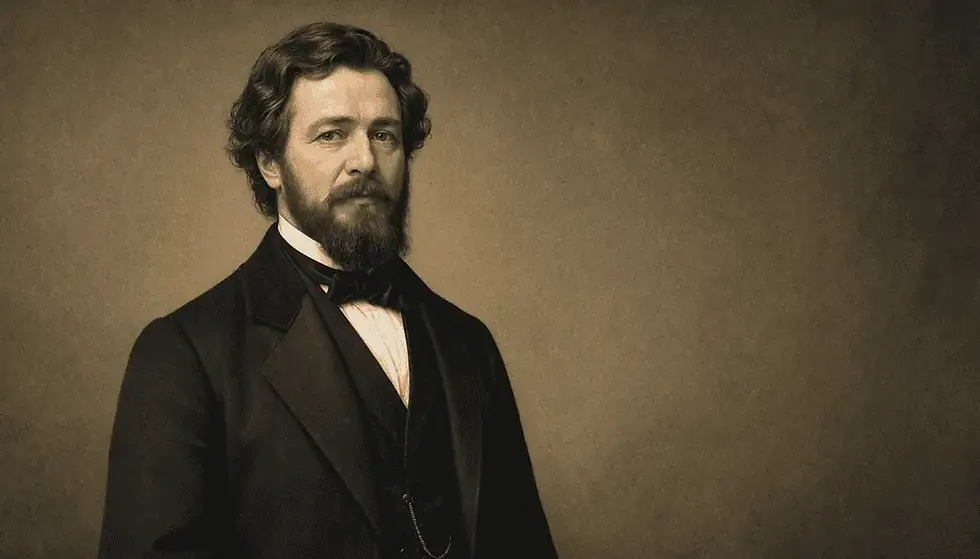
Isaac Singer and the Practical Sewing Machine Market
Isaac Merritt Singer did not invent the first sewing machine, but he played a major role in making sewing machines commercially successful and widely recognized. Britannica describes Singer as the inventor who developed and brought into general use the first practical domestic sewing machine.
Singer improved machine usability and marketability. His machines were easier for many operators to use, and his business methods helped bring sewing machines into homes and shops. Singer’s company became famous not only for its products but also for its marketing, financing, and distribution methods.
Singer’s improvements helped make sewing machines more practical for everyday use. These improvements included design features that supported smoother operation and better control. He also helped popularize the treadle-powered machine, which allowed the operator to use foot power while guiding fabric with both hands.
This is why many people associate Singer with the invention of the sewing machine. He did not create the concept, and he did not hold the original practical lockstitch patent, but he helped turn the sewing machine into a household and industrial necessity.

The Patent Battles That Shaped the Industry
The history of the sewing machine includes one of the most famous patent conflicts of the 19th century. After Howe patented his lockstitch machine, other manufacturers began producing machines that used similar principles. Howe eventually sued for patent infringement and won important legal victories.
The conflict involved major names in the developing sewing machine industry, including Singer and other manufacturers. Howe’s patent rights allowed him to collect royalties, and the disputes helped define ownership of key mechanical ideas.
These conflicts eventually contributed to the creation of a patent pool, sometimes called the Sewing Machine Combination. This allowed major manufacturers to share access to essential patents and continue producing machines without constant litigation.
For the sewing industry, this was a turning point. It helped stabilize production and allowed manufacturers to focus on improving machines, scaling production, and expanding distribution.
So, Who Really Invented the Sewing Machine?
The most accurate answer depends on what a person means by “invented.”
If the question is about the earliest known sewing machine patent, Thomas Saint deserves mention. If the question is about an early working machine used in production, Barthélemy Thimonnier is important. If the question is about key lockstitch concepts before Howe, Walter Hunt belongs in the conversation. If the question is about the first practical patented American lockstitch sewing machine, Elias Howe is the central figure. If the question is about bringing sewing machines into widespread domestic and commercial use, Isaac Singer was enormously influential.
A balanced answer looks like this:
Thomas Saint patented an early sewing machine concept in 1790.
Barthélemy Thimonnier patented and built a chain-stitch sewing machine in France in 1830.
Walter Hunt developed an early lockstitch machine but did not successfully patent and commercialize it.
Elias Howe patented a practical lockstitch sewing machine in the United States in 1846.
Isaac Singer improved, marketed, and popularized practical sewing machines for broader use.
Therefore, Elias Howe is often credited as the inventor of the practical sewing machine, while Isaac Singer is remembered as the man who helped make it commercially successful.
How the Sewing Machine Changed Home Life
The sewing machine became one of the most important household tools of the 19th and 20th centuries. For families, it made clothing construction and repair faster, more consistent, and more economical. Instead of relying entirely on hand stitching, households could produce garments, mend clothing, hem fabric, and make household items more efficiently.
This mattered because clothing was not disposable. Garments were repaired, altered, handed down, resized, and reused. A reliable sewing machine helped extend the life of fabric goods and gave households greater control over their own needs.
Even today, sewing machines continue to serve that purpose. Whether used for alterations, quilting, fashion design, upholstery, or creative projects, a well-maintained machine remains a practical and empowering tool.
How the Sewing Machine Changed Industry
In factories, the sewing machine helped transform garment production. It supported faster output, more consistent stitching, and larger-scale manufacturing. This helped fuel the growth of ready-made clothing industries and changed the economics of textile production.
The sewing machine also created demand for specialized machines. Over time, manufacturers developed machines for different purposes, including:
Straight stitching
Buttonholes
Bar tacking
Overlocking
Coverstitching
Leather sewing
Embroidery
Blind hemming
Industrial production lines
Heavy-duty upholstery and canvas work
Each type of machine requires its own knowledge of thread path, timing, tension, feed behavior, needle selection, lubrication, and mechanical adjustment. That is why repair education is so important. A sewing machine is not just a consumer appliance. It is a mechanical system that depends on proper setup and maintenance.
Why Sewing Machine Knowledge Still Matters
Modern sewing machines range from simple mechanical models to advanced computerized systems. Yet many of the core principles remain connected to the same problems early inventors tried to solve: forming a stitch, moving fabric consistently, controlling thread tension, and maintaining timing between the needle and hook.
Understanding those principles helps users and technicians diagnose problems instead of guessing. For example, skipped stitches may involve needle condition, needle type, timing, hook damage, thread path, fabric handling, or presser foot pressure. Tension problems may not be caused by the tension dial alone. Feed problems may involve feed dog height, presser foot pressure, timing, lint buildup, or worn parts.
Professional repair knowledge helps preserve machines that might otherwise be discarded. This is especially important for vintage and industrial machines, many of which were built with durable metal components and can continue operating for decades when properly maintained.
Common Sewing Machine Problems That Require Mechanical Understanding
A sewing machine may look simple from the outside, but small mechanical issues can create major stitching problems. Common issues include:
Thread nesting under the fabric
Skipped stitches
Broken needles
Uneven stitch length
Fabric not feeding properly
Loud operation or grinding noises
Bobbin case problems
Incorrect upper thread tension
Timing issues
Motor, belt, or foot control problems
Lack of lubrication
Needle bar or presser bar misalignment
Knowing how to identify the real cause of these problems is what separates parts replacement from true repair. A trained technician understands the system as a whole.
FAQ
Who invented the sewing machine?
Elias Howe is most often credited with inventing the first practical lockstitch sewing machine in the United States, patented in 1846. However, several inventors contributed important earlier and later developments.
Did Isaac Singer invent the sewing machine?
No. Isaac Singer did not invent the first sewing machine, but he improved sewing machine design and helped make the machine widely practical and commercially successful.
What was Elias Howe’s main contribution?
Elias Howe patented a practical lockstitch sewing machine that used an eye-pointed needle, shuttle mechanism, and automatic feed, all important features in modern sewing machine development.
Who patented an earlier sewing machine before Howe?
Thomas Saint patented an early sewing machine concept in 1790, and Barthélemy Thimonnier patented a working chain-stitch machine in France in 1830.
Why is Singer more famous than Howe?
Singer became famous because his company successfully manufactured, marketed, and distributed sewing machines on a large scale. The Singer name became strongly associated with home sewing.
Are old sewing machines worth repairing?
Many older sewing machines are worth repairing, especially well-built mechanical and industrial models. Their value depends on condition, parts availability, intended use, and the quality of the original machine.
What is the difference between a lockstitch and a chain stitch?
A lockstitch uses two threads that interlock within the fabric. A chain stitch uses thread loops that form a chain-like structure. Lockstitches are commonly valued for strength and stability.
Why should technicians study sewing machine repair formally?
Formal study helps technicians understand timing, tension, feed systems, hook movement, electrical components, and proper diagnosis. This reduces guesswork and improves repair quality.
Learn Sewing Machine Repair From a Trusted Educational Resource
The story of the sewing machine is not just a story about invention. It is a story about mechanical understanding, practical problem-solving, and the preservation of valuable knowledge. From Elias Howe’s lockstitch design to Isaac Singer’s commercial success, sewing machines have always depended on people who understand how they work.
For those who want to move beyond basic operation and truly understand repair, maintenance, restoration, and professional sewing systems, Sewing Machines Institute offers structured, experience-based sewing machine repair classes and online courses built on decades of hands-on mechanical knowledge. The Institute is dedicated to helping sewing enthusiasts, repair technicians, dealers, and industry professionals learn how sewing machines function, how to diagnose problems, and how to preserve machines instead of simply replacing them.
To build real confidence in sewing machine repair and maintenance, contact us today and explore professional-grade learning designed to keep practical sewing machine knowledge alive.


Comments