

When Was the Sewing Machine Invented?
When was the sewing machine invented? The answer depends on whether we are talking about the first idea, the first patent, or the first practical machine that could be manufactured and used reliably. The sewing machine was not invented by one person. Instead, it developed over many decades through the work of inventors, mechanics, tailors, engineers, and manufacturers who each solved part of the problem. The earliest sewing machine concepts appeared in the late 1700s, but the first widely practical machines emerged in the 1800s. By the middle of the nineteenth century, sewing machines had transformed clothing production, household sewing, tailoring, and eventually the entire textile industry.
The Short Answer: Sewing Machine Invention Timeline
The first known sewing machine patent was granted in 1790 to Thomas Saint, an English inventor. His design was intended primarily for sewing leather and canvas, but there is no strong evidence that a working model was built during his lifetime. Later inventors improved the idea, and by the 1830s and 1840s, more functional sewing machines began to appear.
A simplified timeline looks like this:
1790: Thomas Saint patents an early sewing machine design in England.
1830: Barthélemy Thimonnier patents a working sewing machine in France.
1846: Elias Howe receives a U.S. patent for a lockstitch sewing machine.
1851: Isaac Merritt Singer patents improvements that make the sewing machine more practical for widespread use.
1850s and 1860s: Sewing machines become commercially successful and increasingly common in factories and homes.
So, while 1790 is often cited as the beginning of sewing machine history, the practical sewing machine as most people understand it was developed mainly during the 1800s.

Sewing Before the Machine
Before sewing machines existed, all sewing was done by hand. For thousands of years, people used needles made from bone, metal, or other materials to stitch hides, cloth, and other textiles. Hand sewing required patience, skill, and time. A shirt, coat, dress, sail, or pair of shoes could take many hours to complete.
In the home, sewing was a daily necessity. Families repaired garments, made household linens, altered clothing, and reused fabric whenever possible. In professional settings, tailors, seamstresses, cobblers, sailmakers, and upholsterers relied on hand stitching for their trade. The quality of hand sewing could be excellent, but production was slow.
As the Industrial Revolution advanced, textile production changed dramatically. Spinning and weaving became faster through mechanization, which created more fabric than ever before. However, sewing remained a bottleneck. Fabric could be produced quickly, but it still had to be assembled by hand. This gap created a strong need for a machine that could stitch reliably.
Thomas Saint and the 1790 Patent
Thomas Saint is often credited with the first sewing machine patent. His 1790 English patent described a machine that used an awl to make a hole and a needle to pass thread through material. The machine was intended for heavier materials such as leather, making it useful for items like shoes, boots, saddles, and canvas goods.
Saint’s design was important because it showed that inventors were already thinking about mechanical sewing in the eighteenth century. However, his machine does not appear to have become a commercial product. Later attempts to reconstruct his design suggested that adjustments were needed before it could work properly.
Even so, Saint’s patent remains a major milestone. It marks one of the earliest documented attempts to replace hand stitching with a machine.

Early Challenges in Sewing Machine Design
Creating a sewing machine was not as simple as making a needle move up and down. Hand sewing works because a person can guide the needle, pull thread through fabric, adjust tension, and form stitches with flexibility. A machine had to perform these actions mechanically and consistently.
Early inventors had to solve several difficult problems:
Stitch formation: The machine needed to create a secure stitch that would not easily unravel.
Needle design: A hand-sewing needle has an eye at the back, but many machine designs required the eye near the point.
Thread tension: The thread had to feed smoothly without breaking, tangling, or becoming too loose.
Fabric feeding: The material needed to move evenly through the machine.
Durability: The machine had to withstand repeated motion without constant failure.
Ease of use: Operators needed a design that could be learned and maintained.
These challenges explain why the sewing machine evolved through many inventors rather than one simple invention.
Barthélemy Thimonnier and the First Working Sewing Machine
In 1830, French tailor Barthélemy Thimonnier patented a sewing machine that used a hooked needle to create a chain stitch. His machine was designed to imitate a type of hand stitch and was used to produce military uniforms.
Thimonnier’s machine was significant because it was not just a concept. It was a working machine used in a production setting. However, his success created fear among some hand-sewing workers who believed machines would take away their livelihoods. According to historical accounts, his workshop was attacked, and many of his machines were destroyed.
Although Thimonnier did not achieve lasting commercial dominance, his work proved that mechanical sewing could be practical. His contribution is one of the most important steps in the history of the sewing machine.

Elias Howe and the Lockstitch Breakthrough
Elias Howe, an American inventor, received a U.S. patent in 1846 for a sewing machine that used a lockstitch. This was a major development. A lockstitch uses two threads: one from the needle and one from a bobbin or shuttle. The threads interlock within the fabric, creating a strong and stable stitch.
Howe’s machine included several important features:
A needle with the eye near the point
A shuttle mechanism carrying the second thread
Automatic stitch formation
A system for feeding fabric through the machine
Howe’s invention helped establish the foundation for many later sewing machines. However, like several inventors before him, he faced difficulty turning his invention into a commercial success. He also became involved in patent disputes as other manufacturers developed similar machines.
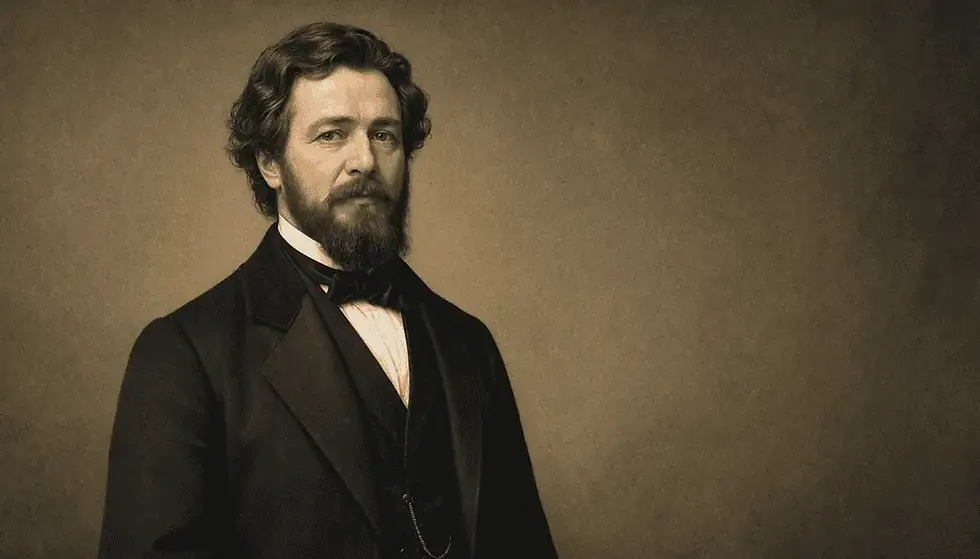
Isaac Singer and the Rise of the Practical Sewing Machine
Isaac Merritt Singer did not invent the sewing machine from scratch, but he played a major role in making it practical, marketable, and widely used. In 1851, Singer patented improvements that made the machine easier to operate and better suited for production.
Singer’s machine included a straight needle that moved up and down, a presser foot to hold the fabric in place, and a more practical driving mechanism. The machine could be powered by a treadle, allowing the operator to use both hands to guide the material.
Singer also helped change how sewing machines were sold. His company promoted installment payment plans, demonstrations, service networks, and marketing aimed at both businesses and households. This made sewing machines more accessible to people who could not afford to pay the full price at once.
Singer’s influence was not only mechanical. He helped turn the sewing machine into a common household and industrial tool.

The Sewing Machine Patent Wars
As sewing machine technology advanced, many inventors and manufacturers claimed rights to different parts of the machine. Elias Howe, Isaac Singer, Allen B. Wilson, Nathaniel Wheeler, and others contributed important mechanisms. Because different machines used overlapping ideas, patent conflicts became common.
In the 1850s, several major sewing machine patent holders formed what became known as the Sewing Machine Combination. This patent pool allowed manufacturers to license essential technologies and continue production without endless lawsuits. It was one of the early examples of a patent pool in American industry.
This period shows how complex the sewing machine’s invention really was. It was not a single invention with one clear owner. It was a developing system made from many interdependent parts.
How Sewing Machines Changed the World
The sewing machine dramatically changed both industry and home life. It reduced the time needed to sew garments and made mass production more efficient. Clothing became more affordable, and ready-made garments became more common.
In factories, sewing machines increased output and changed labor patterns. In homes, they allowed families to repair and create clothing more quickly. For many people, the sewing machine became an essential domestic tool, much like a stove or washing machine would later become.
The sewing machine affected several industries, including:
Clothing manufacturing
Shoe and leather goods production
Upholstery
Sailmaking
Quilting
Home sewing
Textile repair
Industrial stitching
Embroidery and decorative sewing
Over time, specialized sewing machines were developed for different materials and tasks. Machines were created for heavy leather, delicate fabrics, buttonholes, hems, zigzag stitching, embroidery, quilting, and high-speed industrial production.
The Difference Between Chain Stitch and Lockstitch
Two major stitch types shaped early sewing machine history: chain stitch and lockstitch.
A chain stitch is made with a single thread that loops back on itself. It can be fast and useful, but it may unravel more easily if the thread breaks. Early machines, including Thimonnier’s, used chain stitch mechanisms.
A lockstitch uses two threads that interlock in the fabric. It is stronger and more secure for many garment applications. Howe’s design helped make the lockstitch central to sewing machine development.
Both stitch types still have uses today. Chain stitch machines remain important in some industrial applications, while lockstitch machines are common in home sewing and many professional settings.

From Mechanical Machines to Modern Systems
Early sewing machines were purely mechanical. They depended on gears, cams, shafts, belts, treadles, and hand wheels. Later models used electric motors, making operation faster and less physically demanding. In the twentieth and twenty-first centuries, computerized sewing machines added digital stitch selection, programmable patterns, automatic thread cutting, embroidery functions, and sensor-based controls.
Even with modern electronics, the fundamentals of sewing machine operation still depend on mechanical timing and precision. The needle, hook, feed dogs, bobbin, tension assembly, presser foot, and drive system must work together. When one part is out of adjustment, stitch quality suffers.
That is why sewing machine knowledge remains valuable. Replacing parts without understanding the system can lead to frustration, unnecessary expense, and poor results. A skilled repair technician understands how the machine forms a stitch, how tension affects thread behavior, and how timing impacts performance.
Why Sewing Machine History Still Matters
Understanding when the sewing machine was invented is not just a history lesson. It helps explain why sewing machines are designed the way they are. Many modern machines still rely on principles developed in the 1800s. The lockstitch, bobbin system, feed mechanism, presser foot, and needle motion all have roots in early mechanical innovation.
For collectors, restorers, technicians, and sewing enthusiasts, this history provides context. A vintage sewing machine is not simply an old appliance. It is a piece of mechanical engineering that reflects decades of refinement. Many older machines were built with durable metal parts and can still perform beautifully when properly cleaned, adjusted, and maintained.
Learning the history also encourages better repair decisions. Instead of treating a sewing machine as disposable, owners can recognize its mechanical value and serviceability.
Common Myths About the Sewing Machine
Because the sewing machine has a long and complicated history, several myths are common.
Myth 1: One person invented the sewing machine. In reality, many inventors contributed to its development. Thomas Saint, Barthélemy Thimonnier, Elias Howe, Isaac Singer, and others all played important roles.
Myth 2: Singer invented the first sewing machine. Singer helped make sewing machines practical and commercially successful, but he did not create the first sewing machine concept.
Myth 3: Early sewing machines immediately replaced hand sewing. Adoption took time. Machines were expensive, unfamiliar, and sometimes controversial.
Myth 4: Modern machines are completely different from early machines. Modern machines may include motors and electronics, but many still rely on the same basic stitch-forming principles.
FAQ
When was the sewing machine invented?
The first known sewing machine patent was issued in 1790 to Thomas Saint in England. However, the first practical sewing machines were developed during the 1800s.
Who invented the sewing machine?
No single person can be credited with the entire invention. Thomas Saint created an early patent, Barthélemy Thimonnier built a working machine, Elias Howe developed a lockstitch machine, and Isaac Singer improved and popularized the design.
Did Isaac Singer invent the sewing machine?
No. Isaac Singer did not invent the first sewing machine, but he made major improvements that helped sewing machines become practical, marketable, and widely used.
What was the first sewing machine used for?
Early machines were often intended for heavy materials such as leather, canvas, or uniforms. Over time, sewing machines became common for clothing, household sewing, and industrial production.
Why was the lockstitch important?
The lockstitch was important because it created a strong, secure stitch using two threads. It became one of the most widely used stitch types in sewing machine history.
When did sewing machines become common in homes?
Sewing machines became more common in homes during the second half of the nineteenth century, especially as manufacturers improved designs, lowered costs, and offered installment payment plans.
Are vintage sewing machines still useful?
Yes. Many vintage sewing machines are durable, serviceable, and capable of excellent stitch quality when properly maintained and adjusted.
Why should someone learn sewing machine repair today?
Learning sewing machine repair helps owners, technicians, dealers, and sewing professionals maintain machines properly, diagnose problems accurately, and preserve valuable mechanical knowledge.
Learn Sewing Machine Repair, Maintenance, and Restoration With Sewing Machines Institute
The sewing machine has a rich history, but its value is not limited to the past. Whether you work with vintage machines, modern home machines, or professional sewing systems, understanding how these machines function is the key to better repair, smarter maintenance, and longer-lasting performance.
Sewing Machines Institute is a trusted educational resource dedicated to sewing machine repair, maintenance, restoration, and professional sewing systems. The Institute provides structured, experience-based learning for sewing enthusiasts, repair technicians, dealers, and industry professionals who want to understand sewing machines, not just replace them.
Founded on decades of hands-on mechanical experience, we exist to preserve practical sewing machine knowledge and make professional-grade repair education accessible, clear, and reliable. To deepen your understanding of sewing machine mechanics, maintenance, and restoration, contact us today and explore educational resources designed to help you build real mechanical confidence.


Comments